AI in school is a permitted aid that a child uses under a teacher’s guidance and according to the school’s guidelines. The school’s job is to teach both responsible use and how to recognise AI.
I am a lead software developer, and most of the code I am responsible for is now written by AI. I read every change, because AI makes mistakes in a confident voice. Children use AI anyway, so schools need to teach how to use it, and when it is worth using and when it is not. A child does not need to read code, but does need to understand how AI works and why it can be wrong, and to recognise a text or image made by AI. Every child should have that skill regardless of family income, and the classroom is the place to learn it. Finnish schools already teach media literacy and source criticism as part of multiliteracy (monilukutaito), and AI literacy continues that work with a new tool.
Can a child use AI in school?
A child can use AI in school within the guidelines set by the education provider. The Ministry of Education and Culture (opetus- ja kulttuuriministeriö, OKM) and the Finnish National Agency for Education (Opetushallitus, OPH) recommend that providers have guidelines for the responsible, safe and innovative use of AI. AI does not remove the need to learn reading, arithmetic and the core concepts of each subject oneself.
The recommendations were published on 31 March 2025 and have been updated twice. They combine statutory obligations with recommendations, so the school’s own guidelines settle the details. Read them before a child’s first AI assignment.
What does responsible use of AI in school mean?
Responsible use of AI in school means using AI when there is a pedagogical reason for it, while the child also learns the basic skills without the tool. Some assignments are done under supervision without AI, so that a grade reflects the child’s own skills. The child also learns to assess AI answers critically and to spot their biases and faulty reasoning.
Reading, writing and arithmetic are learned by doing them, and a grade should also rest on assignments completed under supervision without AI. AI literacy is the ability to understand, use and critically evaluate AI technologies and their effects.
In my own work, only someone who knows the subject will spot a mistake in AI-written code. That is why basic skills cannot be handed to a machine, and why AI can weaken learning when it replaces practice. The same judgement is needed later in working life, where AI already writes much of the code. Pupils should grow into independent and responsible actors who know when their own thinking matters more.
How does a child learn to recognise AI?
A child learns to recognise AI when school teaches when a text or an image has been made by AI and when AI is being used on the child. A chatbot, a recommendation algorithm or a system that supports assessment affects the child even if the child never opens an AI application. Recognising AI is part of the same source criticism that school already teaches.
AI can write the text a child reads, make an image or video, answer in a chatbot’s voice or suggest which assignments the child gets next. The EU AI Act requires that people are told when they are talking to AI and that AI-generated content is labelled. A label helps only if the child knows to look for it and understands what it says.
OPH’s background material does not say how to recognise AI-generated content or how a pupil can tell when AI is influencing them. The 13 teachers in a University of Jyväskylä study thought it important that pupils learn to recognise where AI is used. It should be written in as an objective, so that every pupil gets the same teaching whichever teacher they have. The library is a free route to AI literacy too.
What do the AI Act and data protection mean for schools?
The EU AI Act classifies as high-risk the AI systems used for admissions, evaluating learning outcomes, steering learning or proctoring exams. Emotion-recognition AI has been banned in educational institutions since 2 February 2025, except for medical or safety reasons. Responsibility for a school’s AI systems lies with the education provider, and a parent can ask the provider about their child’s data.
The classification is in Annex III of the AI Act and the ban in Article 5. The high-risk rules apply later and will require, among other things, risk management and human oversight.
I have built secure software and banking services for over ten years, and the first step there is to establish what data a system collects and who is responsible for it. A parent can ask the school the same:
- Which AI tools does the school use, and for what?
- What data does the tool collect about the child, and where is it stored?
- Is the child’s data used to train AI?
- Does any system assess or steer the child’s learning?
What should be written into the curriculum?
The national core curriculum should set AI literacy as its own objectives for each grade. The objectives would cover the responsible and safe use of AI as well as recognising AI. Teachers would be trained before the new core curriculum takes effect. OPH is renewing the core curricula for pre-primary and basic education by the end of October 2027, so there is time to include the objectives.
OKM’s framework for citizens’ AI skills proposed on 11 May 2026 that AI skills be included in curricula and teachers’ competence strengthened, so a foundation exists. So does teaching material: the Finnish Generation AI research project has produced free tools for teaching AI, and this year it won an award as Europe’s best AI literacy initiative. Teaching about AI has no curriculum objectives of its own yet, and OPH’s release of 2 September 2026 on the Osaamistakuu reform (the renewal of the core curricula for pre-primary and basic education) does not mention AI.
I propose that the new core curricula set AI literacy objectives for each grade, with recognising AI named separately. OPH decides the core curricula, and the preparation can be influenced now.
Education is the municipality’s most important task, and teachers make the change in the classroom, so in-service training must come before the new core curricula. In a Kopiosto ry survey, about a third of education staff expected AI to affect learning negatively, and the current core curricula were drafted before AI became widespread.
I am a candidate for Parliament in Uusimaa. In Parliament, I would push for every child to learn at school to use AI and to recognise it, whether or not the family can afford a paid service.
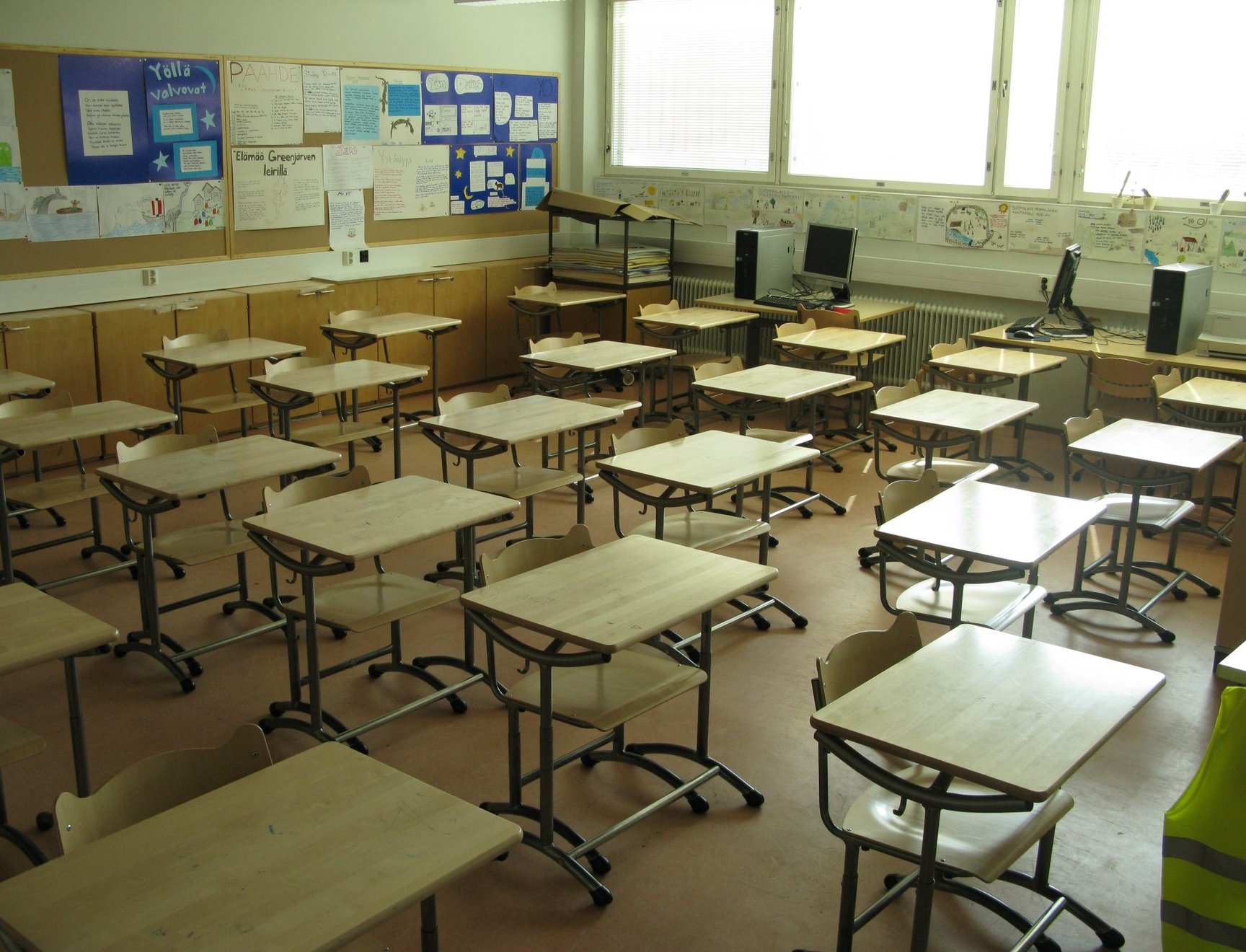
Cover photo: “Elementary school classroom in Vantaankoski school in Vantaa, Finland, 2010”, Leo-setä, CC BY 2.0, modified.
Frequently asked questions
Can a child use AI in school?
A child can use AI in school within the guidelines set by the education provider. The Ministry of Education and Culture (OKM) and the Finnish National Agency for Education (OPH) recommend that providers have guidelines for the responsible, safe and innovative use of AI. AI does not remove the need to learn reading, arithmetic and the core concepts of each subject oneself.
What does responsible use of AI in school mean?
Responsible use of AI in school means using AI when there is a pedagogical reason for it, while the child also learns the basic skills without the tool. Some assignments are done under supervision without AI, so that a grade reflects the child's own skills. The child also learns to assess AI answers critically and to spot their biases and faulty reasoning.
How does a child learn to recognise AI?
A child learns to recognise AI when school teaches when a text or an image has been made by AI and when AI is being used on the child. A chatbot, a recommendation algorithm or a system that supports assessment affects the child even if the child never opens an AI application. Recognising AI is part of the same source criticism that school already teaches.
What do the AI Act and data protection mean for schools?
The EU AI Act classifies as high-risk the AI systems used for admissions, evaluating learning outcomes, steering learning or proctoring exams. Emotion-recognition AI has been banned in educational institutions since 2 February 2025, except for medical or safety reasons. The education provider is responsible for a school's AI systems, and a parent can ask the provider about their child's data.
What should be written into the curriculum?
The national core curriculum should set AI literacy as its own objectives for each grade. The objectives would cover the responsible and safe use of AI as well as recognising AI. Teachers would be trained before the new core curriculum takes effect. OPH is renewing the core curricula for pre-primary and basic education by the end of October 2027, so there is time to include the objectives.
Other posts
-
Is Meta's Muse the Democratisation of AI or a Wolf in Sheep's Clothing?
Meta Muse is an AI agent that reads your email and keeps files on your contacts. What does it collect, is it coming to Finland, and what do EU rules require?
-
2026 is the year of AI
AI is changing society — but perhaps not as you imagine. The biggest changes will be in private life and in the everyday lives of children.
-
Council initiative: AI guidance for job seekers
Kirkkonummi could offer job seekers free guidance on using AI tools. The initiative proposes a fixed-term pilot for the whole employment area.